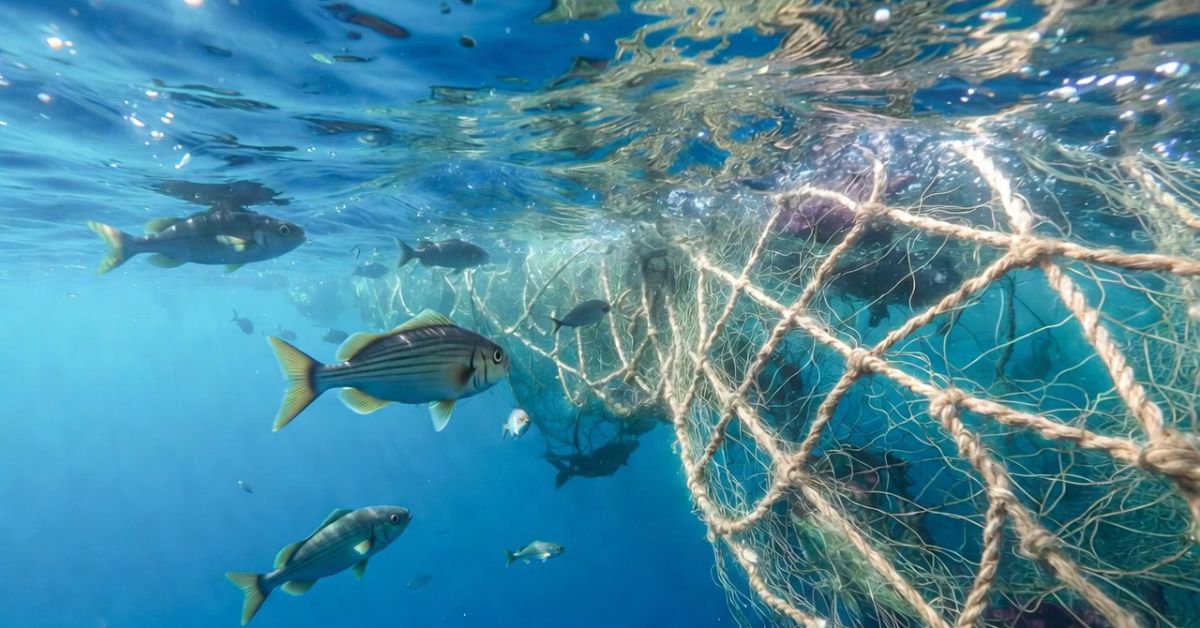
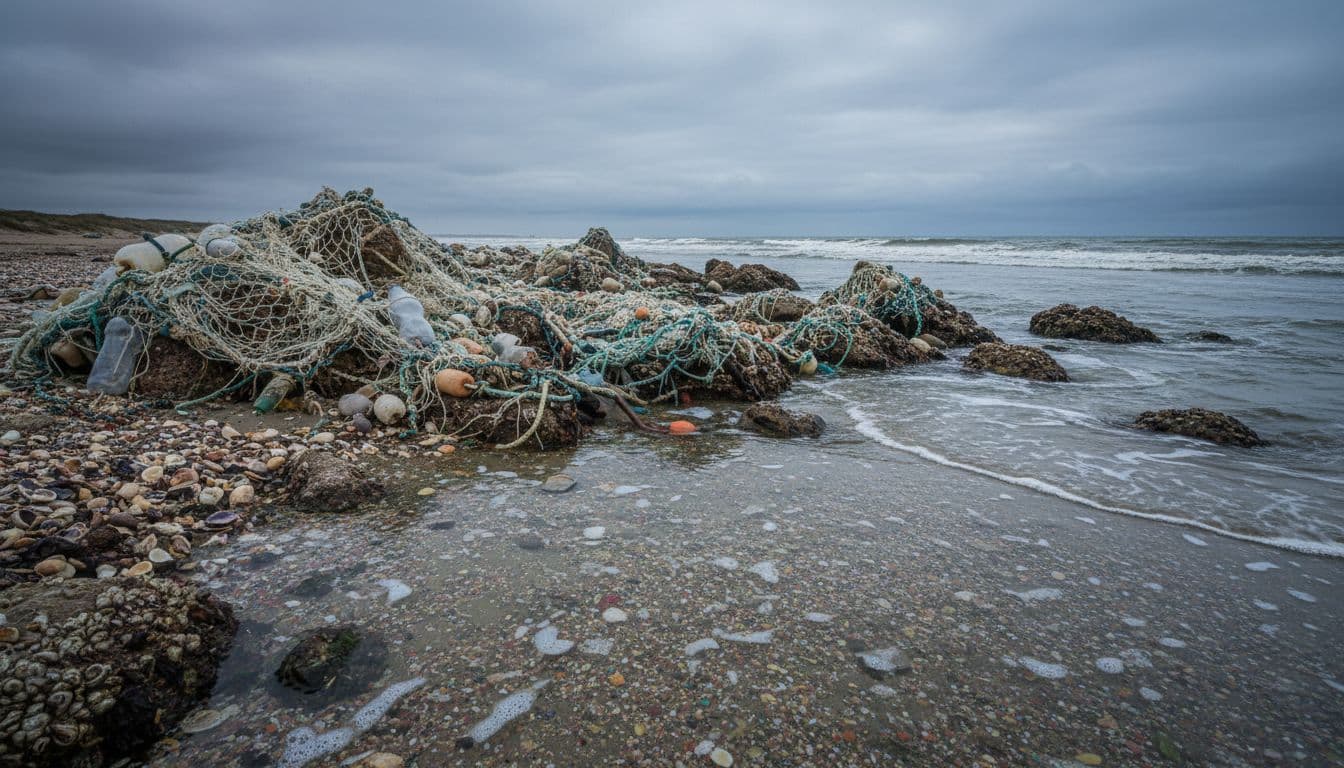
A ghost net in the water is a nightmare, silent, ugly, and still fishing long after it should’ve been retired. It tangles wildlife, scrapes reefs, and becomes one more harsh reminder that our ocean can’t digest our rubbish.
So when surf brands say they’ve turned old nets into gear and apparel, it sounds like a proper fix. Sometimes it is, in fact sometimes it is exceptional. Sometimes it’s also a very tidy bit of marketing. If you’ve read our wider take on sustainability in surfing, you’ll know the same rule applies here, good ideas still need receipts.
Our Souls of the Sea is fully in favour of nets-to-product systems. They can cut virgin plastic use and support better waste collection. But there’s a big difference between stopping nets from becoming marine waste, and cleaning up damage after the fact. That difference matters, and we also need to ask the question, is surf gear the best thing for this recycled material to be utilised for?
For readers who want to go deeper, the Global Ghost Gear Initiative publishes useful videos on ghost gear impacts and prevention, while Patagonia and Bureo offer a clearer look at how end-of-life net collection can feed into products like NetPlus.
What counts as a recycled fishing net product, and where the story often gets fuzzy
The phrase “recycled fishing nets” sounds simple. In practice, it covers several very different material stories, and brands often blur them together.
Here’s a quick cheat sheet:
| Label | What it usually means | What to ask |
|---|---|---|
| Ghost nets | Lost or abandoned gear recovered from sea | Was it actually hauled from the water? |
| End-of-life nets | Retired nets collected through ports, fisheries, or farms | Who collected them, and where? |
| Ocean-bound or pre-ocean plastic | Waste intercepted near coasts before entering the sea | How is that risk zone defined? |
| Regenerated nylon | Nylon chemically broken down and rebuilt | What feedstock went into it? |
| Mechanically recycled plastic | Plastic shredded, melted, and remade | Which part of the product uses it? |
That doesn’t make any of these routes bad. Far from it. It just means the material story may be useful, but less heroic than the hangtag suggests.
“Made from recycled nets” doesn’t always mean “saved from the open ocean”.
Ghost nets are not the same as end-of-life nets
This is the first trap. Ghost nets are gear already lost at sea. They’re the harmful stuff drifting, snagging, and breaking down in the marine environment.
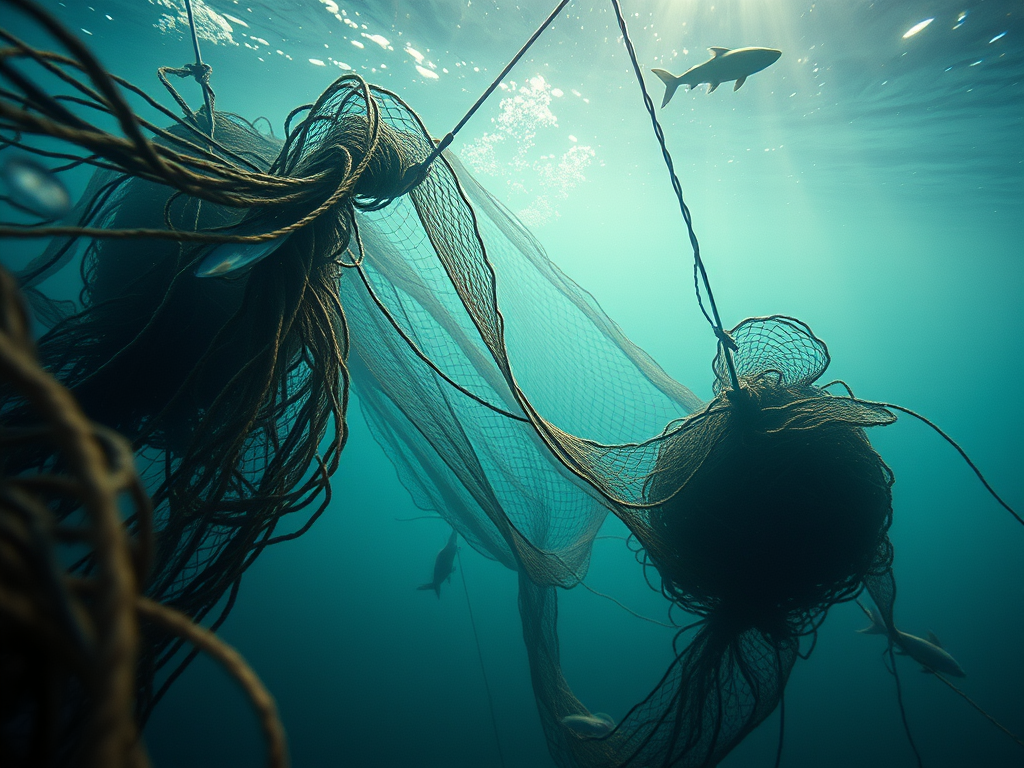
End-of-life nets are different. They’re old nets collected when fishers or aquaculture operators retire them, often through port schemes or recovery partners. That’s still valuable, because prevention beats clean-up every time.
A lot of surf products sold with ocean-saving language come from end-of-life nets, not ghost nets dragged out of the surf zone. That doesn’t make them fake. It just makes the wording a bit slippery.
Why wording like ocean plastic and sea net can be misleading
Vague language lets brands borrow the emotional charge of ocean rescue without being exact. “Sea net”, “ocean plastic”, and “ocean bound” can hide a much drier truth, the material may have come from a managed collection scheme on land.
Pre-ocean diversion is still a positive move and we support it wholeheartedly. It keeps waste from leaking into the water. But it’s not the same as direct ocean clean-up. If a brand wants applause, it should say what it actually did, name the region, and tell you who handled the material, not obfuscate the truth to give their market that extra depth of green.
How recycled fishing nets actually become surf products
Most surf readers will come across two main systems, NetPlus and ECONYL. They work in very different ways, and that’s where the trade-offs start to show.
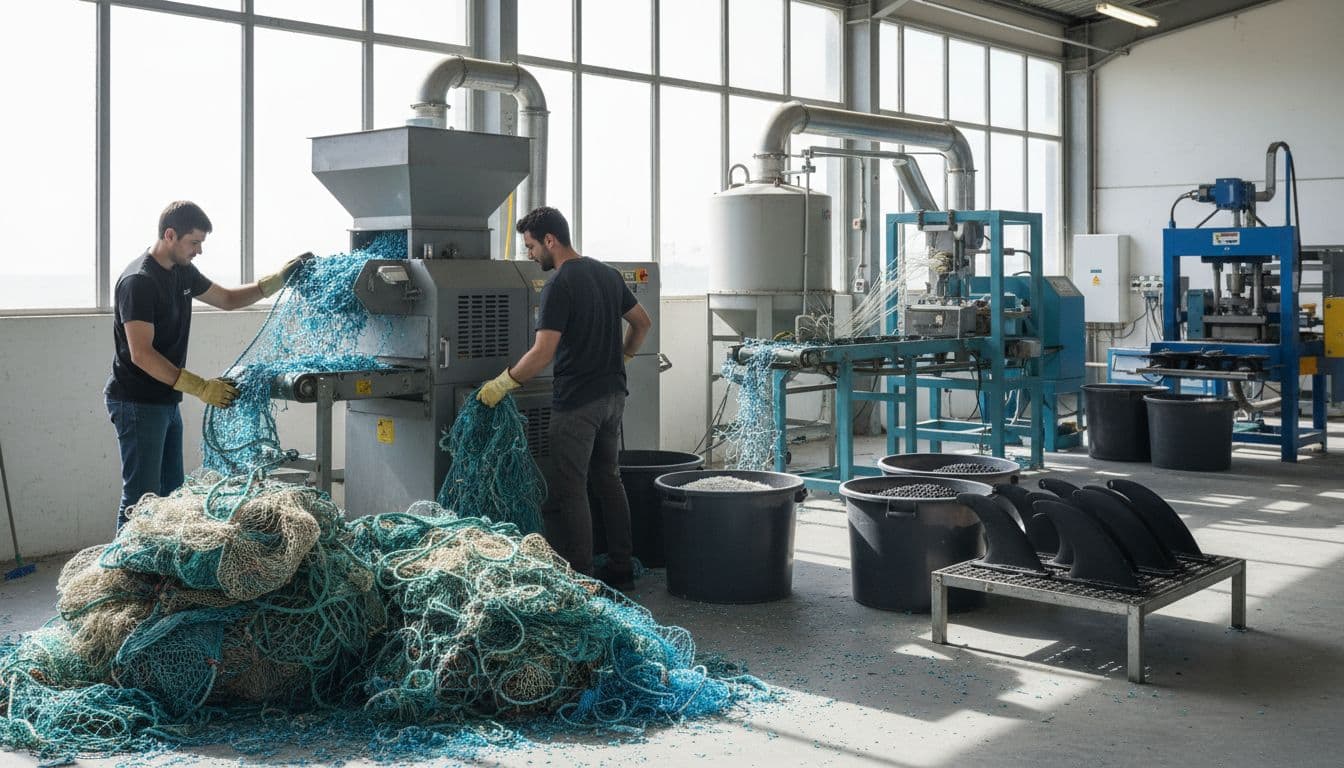
NetPlus, developed by Bureo, is mostly a mechanical recycling pathway. Old fishing nets are collected through community programmes, cleaned, sorted, shredded, and turned into pellets for moulded parts.
That’s why NetPlus works best in rigid items. Think cap brims, sunglass frames, fins, or small surf accessories. You’ll often see NetPlus Patagonia products in that space, because hard components are a natural fit.
The strengths here are clear. Collection partnerships can be traceable, and the system helps keep retired gear out of dumps or waterways. The catch is that mechanical recycling isn’t a perfect endless loop. Polymer quality can drop with repeated processing, so the material may not cycle forever at the same level. If a company is manufacturing extremely long life, or lifetime gear with NetPlus material, we applaud them. However, if the product is short life, easily out of fashion, or a one season fix, we ask why?
ECONYL, breaking nylon 6 back down and building it up again
ECONYL takes a chemical route. Waste nylon is collected, cleaned, broken down to caprolactam, then rebuilt into virgin-quality nylon 6.
That matters because the feedstock can include fishing nets, but also carpet waste and industrial nylon scraps. So an ECONYL product is not automatically “made from ghost nets”, even if that’s the image in your head, or on the hangtag.
For surf gear, this route suits swimwear, rash vests, apparel, and some wetsuit linings. When you see an Econyl tag on a wetsuit, it often means the jersey or lining uses regenerated nylon, not that the whole suit is circular. The foam core is usually a different story.
Chemistry helps, but it doesn’t solve everything. Real circularity still depends on design, take-back, and whether the product can be separated and collected again.
Where recycled nets show up in surfing, and where the gains are real
This is where the material meets actual kit, and some uses make far more sense than others.
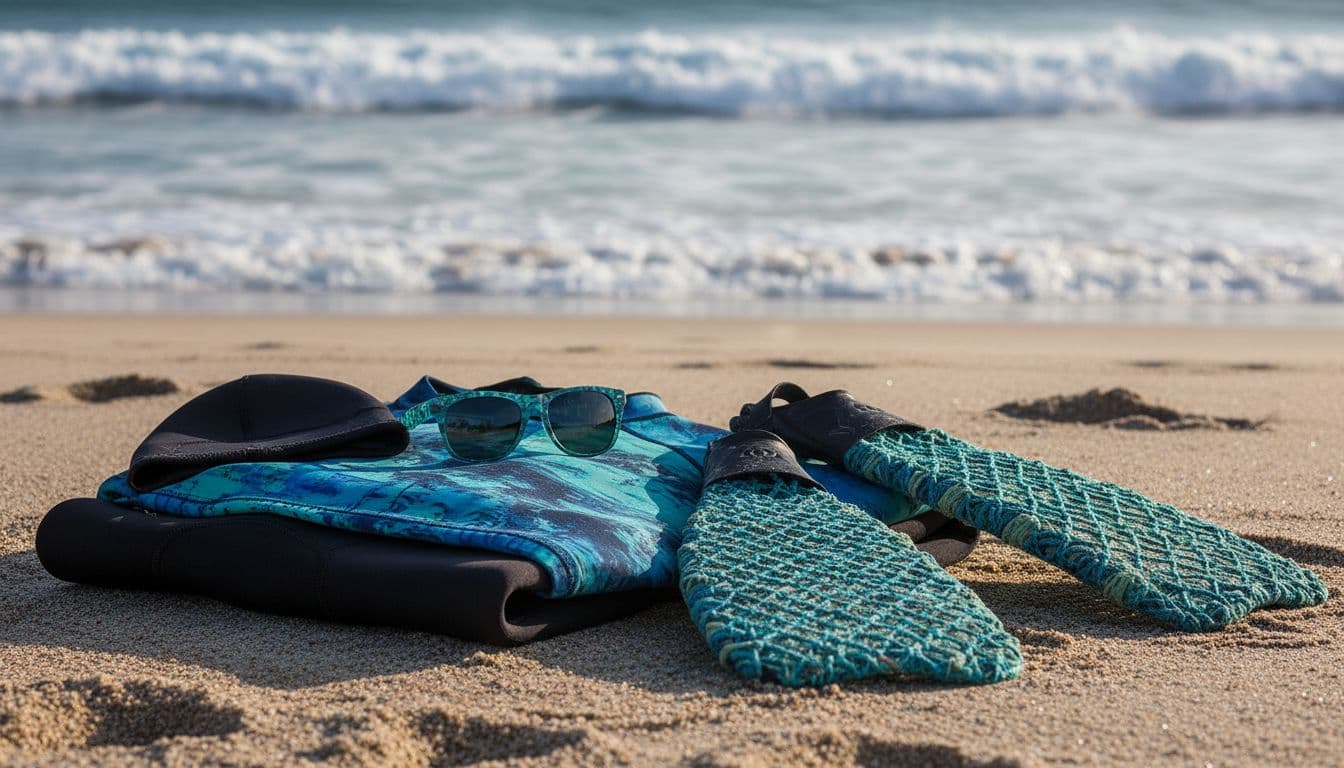
Recycled nylon shows up most clearly in swimwear, rash vests, leggings, and surf tops. In those products, the nylon content can be a big part of the fabric story. That’s why a nylon-rich garment often has a cleaner pathway than a complex wetsuit.
Wetsuits are messier. Even when brands market recycled content, the suit may still rely on neoprene or other foams that are hard to recycle at end-of-life. So the greener story often sits in the lining, face fabric, or trim.
That’s also why mono-material thinking matters. A simpler garment is easier to recycle than one loaded with mixed fibres, prints, tapes, and trims. Brands like SEPTEMBER sustainable surf swimwear show how regenerated nylon can be used thoughtfully. Another solid example is Nomads Surfing, who’s surfboard fins are manufactured with 70% recycled PA6 Nylon.
Caps, sunglasses, fins and board parts made with recycled net plastic
Rigid products are often the cleaner win. Mechanically recycled net plastic can work well in caps, frames, fins, and small hard parts because the material suits the job.
Still, no one gets a free halo for one nice component. A fin made with recycled nets is good news. A fin made with recycled nets, shipped wastefully, packed in throwaway plastic, and designed to fail early, is less impressive.
In surf gear, durability is half the environmental story. The longer a product lasts, the more those recycled inputs actually count.
The uncomfortable truths brands do not put in the headline
Recycled-net materials are usually better than virgin plastic or virgin nylon. That is the fair place to start. But they do not erase the footprint of making, shipping, and washing more synthetic gear. And they do not all represent the same kind of circular win.
Synthetic surf gear can still shed fibres during wear and washing. Recycled content does not magically stop that. A rash vest made from regenerated nylon is still a synthetic garment living in a microfibre world.
Then there is the clean-up work itself. Nets need collecting, sorting, transporting, and cleaning, often after heavy contamination with salt, sand, algae, or biofouling. That takes water, energy, labour, and logistics.
Aquafil, the maker of ECONYL, says its regenerated nylon can cut CO2 impact by roughly 90 per cent compared with virgin nylon 6, but that comparison applies to the polymer stage, not the entire finished product once brands take ownership. That distinction matters.
The same goes for scale. Exact public figures for annual global fishing-net production are surprisingly hard to pin down, but what is clear is that fishing and aquaculture still depend on vast amounts of synthetic gear, and significant amounts are lost or discarded every year. That makes prevention and proper recovery systems far more important than a nice branded Instagram story.
The strongest circular outcome may be turning old nets back into new nets
This is the critique the surf and wider fashion industry often skips.
A T-shirt, cap, or tote made from recycled nets may be better than one made from virgin plastic. But that does not automatically mean it is the best use of the material. In many cases, the stronger circular outcome is old nets becoming new nets.
Why? Because garment producers often have at least some other fibre options. Depending on the product, they may be able to choose organic cotton, hemp, linen, wool, bamboo, or other lower-impact materials. Net manufacturers do not have that same freedom at industrial scale. Modern fishing and aquaculture nets need strength, durability, and performance in brutal marine conditions, and for now that usually means synthetic polymers such as nylon.
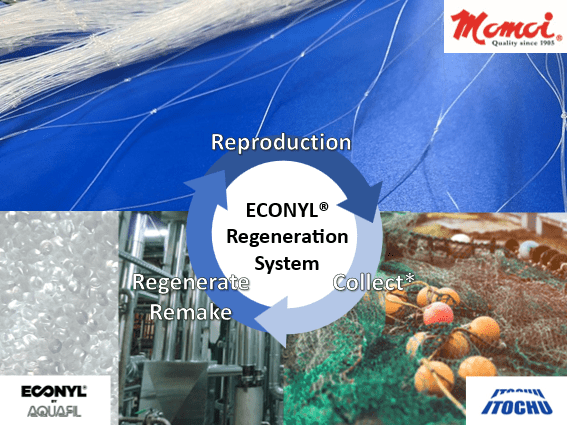
“Recycled materials have not been widely used in fishing nets until now because of their unsatisfactory strength and durability. However, now we developed fishing nets that are made 100% from ECONYL® resin… with the same quality and performances as the virgin ones.” – Momoi Fishing Line
That changes the question. Instead of only asking, “Is this product made from recycled nets?”, we should also ask, “Was this the most useful place to put that recovered nylon?”
If a recovered net becomes a fashion item, the material often leaves the industrial loop and enters the consumer market, where take-back is patchy and end-of-life is murky. If that same nylon goes back into making new nets, it displaces virgin material in a sector that still has few realistic non-synthetic substitutes. That is a far stronger circular story.
Enter Diopas S.A, Philosofish, and Aquafil
A strong example emerged in 2024, when Diopas S.A., working with Philosofish and Aquafil, created what Aquafil described as the world’s first circular aquaculture net made entirely from ECONYL regenerated nylon 6, including the netting, ropes, and sewing threads. Because the whole system uses compatible nylon components, it is designed to be recycled at end-of-life without the usual mixed-material disassembly problem. The first generation was installed at Philosofish’s Ag. Serafeim site in Greece for real-world testing, rather than a full commercial rollout from day one.

Around the same time, ITOCHU, Momoi Fishing Net Mfg., and Kinoshita Fishing Net Mfg. announced the commercialisation of fishing nets made from 100 per cent ECONYL resin. According to the companies, the nets match conventional petroleum-based nylon products in key performance areas such as strength, elongation, and appearance. That is what serious loop design starts to look like, old net to new net, not old net to lifestyle merchandise.
That does not mean surf products made from recycled nets are pointless. Far from it. Durable hard goods can still be a useful outlet, especially when they replace virgin plastic and come with clear traceability. But if brands want to talk seriously about circularity, they should admit that the gold standard may be keeping recovered material in the net system wherever possible.
Not every recycled-net claim means true closed-loop circularity
There is still a huge gap between recycling and closed-loop recycling.
Some products are downcycled into lower-value uses. Some are open-loop, where an old net becomes a cap brim or sunglass frame, but will never become a net again. That still has value, but it is not circular in the purest sense.
The stronger model is mono-material design paired with real collection and regeneration. The 2024 ECONYL aquaculture net example matters because the whole net system is nylon 6, which means it can be chemically regenerated back into new nets again. That is a much clearer closed loop than most consumer goods can currently offer.
Most surf products do not hit that standard. Mixed materials, poor take-back systems, and low recovery rates usually break the loop long before the marketing copy does. So yes, recycled-net surf gear can be a step forward. But we should be honest about what kind of step it is, and where the strongest circular wins may actually live.
How to tell if a recycled-net surf product is worth buying
This is the bit that matters when you’re in the shop, scrolling a launch, or hovering over “add to basket”. Buy less, buy better, and back systems that stop waste before it becomes a beach clean photo.
Five smart checks before you trust the label
- Name the partner: Does the brand tell you who supplied or regenerated the material, such as Bureo or ECONYL?
- Use honest language: Does it explain ghost nets sustainability clearly, or blur end-of-life nets into ocean rescue narrative?
- Show product design: Can it be repaired, taken back, or easily recycled?
- Put recycled content where it counts: Is it a major fabric or component, not a token trim?
- Publish traceability or impact data: Can you find sourcing regions, percentages, or verified claims?
If the whole pitch is salt encrusted mood boards and vague “for the ocean” copy, keep your hand on your wallet.
Care tips that help recycled surf gear last longer
- Rinse with fresh water after surf sessions, especially salt-heavy ones.
- Wash less often, because less washing means less wear.
- Use cool washes when you need them, around 30°C is usually enough.
- Air dry in the shade, not in punishing full sun.
- Repair before replacing, whether that’s a split seam or worn trim.
- Choose long-life gear, not trend pieces built for one season of hype.
The greenest product is often the one already in your quiver.
The real verdict on recycled fishing nets in surf products
Recycled fishing nets in surf products can be a genuine step forward. They matter most when they replace virgin materials, come with traceable sourcing, and connect to real collection systems. But they should never be used to excuse overproduction, fuzzy claims, or another plastic-heavy product drop in a nicer shade of green.
So back the brands that show their working. Support port collection, aquaculture take-back, repair, resale, and smarter design. Above all, keep your eyes on prevention, because the best win is stopping nets from becoming marine waste in the first place.
 Our Souls of the Sea